
BRITISH OBJECTIONS ANSWERED
BRITISH OBJECTIONS ANSWERED
The British arguments against returning the Marbles are:
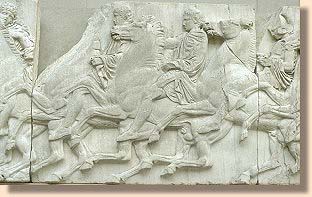
They were bought legitimately.
This argument is invalid because any purchase from the conqueror in a conquered
land is like buying stolen articles from a thief or robber. Anyway, there is
no evidence that the Marbles were purchased legitimately. The various local
Turkish officials were
bribed
by the British with luxurious presents.
They were taken to save them from destruction.
Elgin not only did terrible damage to the Parthenon and the Erechtheum when he
removed their sculptures, he also, in his effort to take as much as he could,
sawed some of the sculptures in half to reduce their weight and make
transporting them easier.
The Greeks were indifferent.
There is little doubt that any Greek protests would have been quickly and
brutally suppressed by the Turks. When the
French
consul in Athens protested at the removal of the Marbles he was
imprisoned
by the Turks.
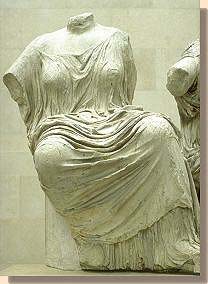
Of course there were indications that the Greeks grieved for their looted treasures, including the myth that the Caryatids could be heard wailing at night for their missing sister, and the claims by porters carrying the statues who thought they could hear cries coming from the figures in the crates.
Edward Dodwell, writing in 1812, also mentions in his book that at the time of his travels in Greece the Athenians were lamenting the ruining of their antiquities and reviling the Turks for giving permission to foreigners to remove them.
 Also in 1812, a group of distinguished Athenians, two of whom were members of
the secret Philike Etairia (Friendly Society), founded the Philomusical Society
(Society of the Friends of Music), whose members included Lord Guildford. One
of the Society's aims was the protection of ancient monuments.
Also in 1812, a group of distinguished Athenians, two of whom were members of
the secret Philike Etairia (Friendly Society), founded the Philomusical Society
(Society of the Friends of Music), whose members included Lord Guildford. One
of the Society's aims was the protection of ancient monuments.
Finally Lusieri himself admitted to Elgin in a letter that "If I cannot remove the entire Pandrossium (the colonnade of the Caryatids) I do not despair about one of the Caryatids. But the Greeks are devoted to it." (i.e. the Pandrossium).
Air pollution would destroy the Marbles
This argument is completely unacceptable because the Marbles suffered far more
damage from their lengthy stay in the heavily polluted atmosphere of London
than they would have done if they had stayed in Athens where pollution is only
a very recent phenomenon.
Lord Elgin admitted to the House of Commons that London's dampness had caused decay to the sensitive Pentelic marble. This was in 1816.
But the fact remains that when an ancient work of art is removed from its original setting it loses most of its value and becomes merely an item of archaeological interest.
The British Museum, to this day, tries to present Elgin as a lover of antiquity who dedicated himself to rescuing Pheidias' sculptures from ultimate destruction. But the facts of the case present a very different picture. With the Sultan's firman in his hand, Elgin seemed to think he had been given the right to take away anything he could lay his hands on. His actions didn't pass unnoticed. A lot of Members of Parliament protested against Elgin's action in the House of Commons but over the course of time were forgotten.
There were also a lot of English writers, among them Lord Byron, who wrote that Elgin was a marble stealer and robber and his only interest was fame and glory from showing the Marbles.
|
|